
RULES OF RECRUITMENT FOR INTERNATIONAL MOBILITY WITHIN THE SEA-NERGY PROJECT
Name
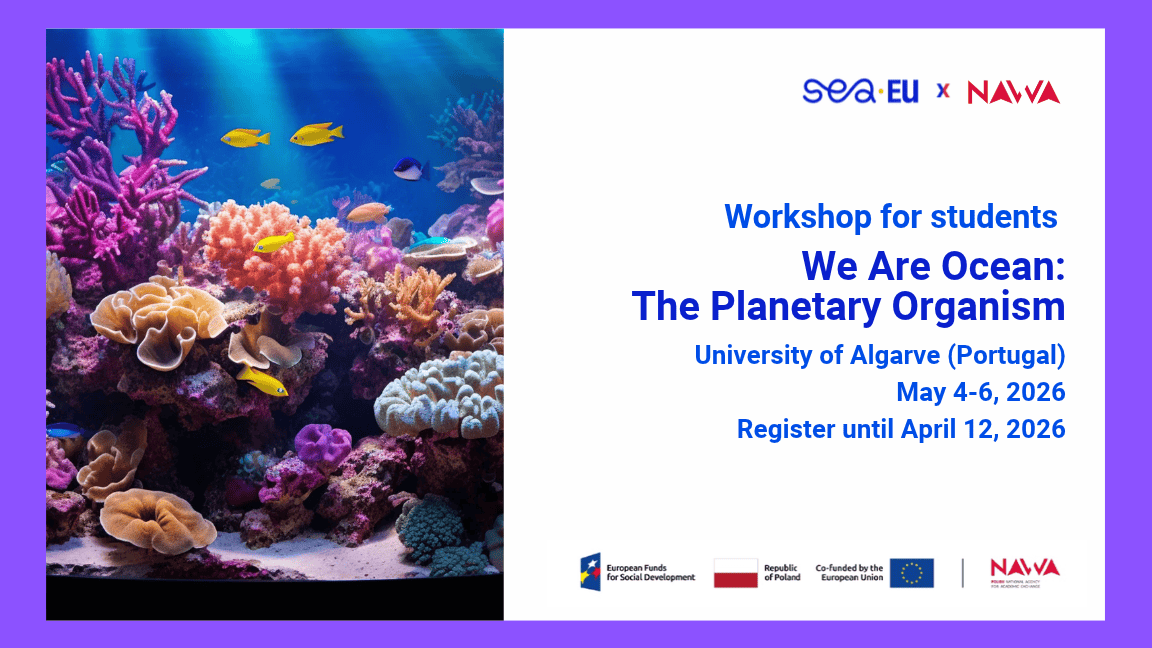
International Workshop “WeOcean the Planetary Organism”
Purpose
The workshop aims to develop an interdisciplinary understanding of the Ocean as a key component of the Earth’s life-support system and to foster awareness of humans as part of that system by integrating scientific knowledge, philosophical reflection, artistic activities and new technologies. It also seeks to explore solutions that promote harmony between humans and nature, support sustainable development and address contemporary environmental and social challenges.
Format and duration of the initiative
The initiative will take place in person at the University of Algarve in Faro, Portugal, a SEA-EU partner university, on 4–6 May 2026. Online participation via YouTube livestream will also be possible.
Programme
The detailed programme is available on the WeOcean website.
Day 1 – 4 May 2026: The Living Ocean – A New Understanding of the Living Planet
- Meditation
- Opening and introduction
- Lectures
- Afternoon sessions
- Debate
- Art workshops
- Concert
Day 2 – 5 May 2026: Expanding Reality – New Ways of Perceiving Our Relationship with the Planet
- Meditation
- Lectures
- Breaks
- Nature walk (Ria Formosa)
- Sensory activities on the beach
- Debate
Day 3 – 6 May 2026: A Shared Future? The Social Implications of Being Part of a Living Planet
- Meditation
- Lectures (science communication, human–nature relationships)
- Debates
- Summary
- Closing session
LEARNING OUTCOMES
Set of learning outcomes (competences)
- Knowledge of the interdisciplinary understanding of the Ocean as a central component of the Earth’s life-support system, particularly in the context of the “living planet” concept and current challenges relating to the climate crisis and environmental degradation.
- Ability to interpret and analyse human–nature relationships from scientific, philosophical and social perspectives, integrating different viewpoints to better understand the need for harmony with nature.
- Social competences for informed participation in activities aimed at protecting the Ocean and the environment, including openness to interdisciplinary dialogue, cooperation and a sense of responsibility for the planet’s shared future.
Detailed learning outcomes
Knowledge
- 1.1. Understands the Ocean as a key component of the Earth’s life-support system and its importance for the functioning of the planet.
- 1.2. Understands the “living planet” concept and the links between natural, social and climate processes.
- 1.3. Is familiar with major contemporary environmental challenges, including the climate crisis and the degradation of marine ecosystems.
Skills
- 2.1. Can analyse human–nature relationships from scientific, philosophical and social perspectives.
- 2.2. Can integrate knowledge from different disciplines to interpret complex environmental issues.
- 2.3. Can formulate conclusions and arguments concerning the need for Ocean protection and sustainable development.
Social competences
- 3.1. Demonstrates awareness of responsibility for the natural environment, particularly the Ocean.
- 3.2. Is open to interdisciplinary dialogue and diverse perspectives.
- 3.3. Can cooperate in an international environment, engaging in activities that promote environmental protection and the common good.
Learning outcome assessment criteria
| Learning outcome | Assessment criteria | Assessment method |
|---|---|---|
| 1.1. Understands the Ocean as a key component of the Earth’s life-support system and its importance for the functioning of the planet. | 1.1.1. Explains the role of the Ocean in the Earth’s life-support system; 1.1.2. Gives examples of processes occurring in the Ocean and their impact on the planet. | Test |
| 1.2. Understands the “living planet” concept and the links between natural, social and climate processes. | 1.2.1. Describes the assumptions underlying the “living planet” concept; 1.2.2. Identifies links between natural, social and climate processes. | Test |
| 1.3. Is familiar with major contemporary environmental challenges, including the climate crisis and the degradation of marine ecosystems. | 1.3.1. Lists major environmental issues affecting the Ocean; 1.3.2. Describes selected phenomena related to climate change. | Test |
| 2.1. Can analyse human–nature relationships from scientific, philosophical and social perspectives. | 2.1.1. Analyses a selected issue from different perspectives; 2.1.2. Formulates arguments in a discussion concerning human–nature relationships. | Test |
| 2.2. Can integrate knowledge from different disciplines to interpret complex environmental issues. | 2.2.1. Combines information from different fields of knowledge; 2.2.2. Develops a coherent interpretation of an environmental issue. | Test |
| 2.3. Can formulate conclusions and arguments concerning the need for Ocean protection and sustainable development. | 2.3.1. Formulates logical conclusions concerning environmental protection; 2.3.2. Justifies a position based on the material presented. | Test |
| 3.1. Demonstrates awareness of responsibility for the natural environment, particularly the Ocean. | 3.1.1. Expresses a responsible attitude towards the environment; 3.1.2. Identifies possible actions to protect it. | Test |
| 3.2. Is open to interdisciplinary dialogue and diverse perspectives. | 3.2.1. Participates actively in discussion, taking different viewpoints into account; 3.2.2. Demonstrates openness to new ideas and approaches. | Test |
| 3.3. Can cooperate in an international environment, engaging in activities that promote environmental protection and the common good. | 3.3.1. Cooperates with other participants in completing tasks; 3.3.2. Engages in environmentally focused team activities. | Test |
REQUIREMENTS FOR THE INITIATIVE
Participants
Students and doctoral students whose studies are related to the workshop topics may apply. Applicants may not apply for or participate in the programme while on any type of leave.
Recruitment
Everyone applying must complete the registration form. The form includes a motivation letter explaining the choice of mobility, which should contribute to the development of competences. The letter must explain how the mobility topic relates to the applicant’s field of study and how participation will contribute to their development. The form must be completed and submitted by 12 April 2026.
Funding will be awarded according to the total number of points obtained. Applications with higher scores will be given priority and processed in ranking-list order. Funding is available for 5 participants.
Only applicants who submit all required documents and meet the above requirements may be selected for mobility.
Recruitment will comply with the horizontal principles described in § 2(8) of the Project Regulations. Applicants with disabilities or special needs who require assistance during recruitment should contact the task coordinator at seaenergy@ug.edu.pl.
Recruitment criteria
| Formal criteria | Requirement met | |
|---|---|---|
| Student status | — | |
| Application approved by the Organiser | — | |
| Initial English language proficiency of at least B2 | — | |
| Complete application | — | |
| No. | Substantive assessment criteria | Points |
| 2 | Substantive assessment of the motivation letter explaining the choice of mobility, which should contribute to the development of competences. | 0–5 |
| 3 | Assessment of the information provided in the motivation letter on how the mobility topic corresponds to the applicant’s field of study. | 0–5 |
| 4 | Assessment of the proposed application of knowledge and skills acquired during the workshop in the applicant’s thesis, as described in the motivation letter. | 0–5 |
Recruitment results
The committee responsible for verifying and assessing applications must prepare a ranking list distinguishing between selected applicants, reserve-list applicants and those who do not meet the criteria. All applicants will be informed individually of the results by email by 14 April 2026. The list of selected applicants will also be published in the Oferta section of the SEA-EU website.
RULES FOR PROVIDING SUPPORT
Participation in the mobility is free of charge for eligible University of Gdańsk students who have been selected.
Funding
Funding may be awarded for mobility taking place on 4–6 May 2026, plus two travel days. The funding must cover travel, accommodation and subsistence costs. Detailed funding rates are available in the funding rates document.
Pre-mobility documentation
Selected participants are required to:
- Complete an online pre-test in which they self-assess their competences before the workshop.
- Register on the NAWA platform to confirm their eligibility as project participants.
- Sign the student mobility agreement or, in the case of doctoral students, the doctoral student mobility agreement.
Post-mobility documentation
Participants who complete the initiative are required to:
- Complete an online post-test in which they self-assess their competences after the workshop.
- Present the original certificate of attendance at the partner university.
- Submit the event programme bearing the Organiser’s stamp and signature.
Completion of mobility
Participants who complete the mobility will receive a certificate of participation. Verification of learning outcomes requires completion of a post-test, in which the participant must achieve a higher score than in the pre-test to receive a certificate confirming the development of competences. Both tests are completed remotely via Microsoft Forms.
Contact
The initiative is implemented as part of the project “Support for Synergistic and Complementary Activities of the SEA-EU 2.0 Project – SEA-nergy”, under the NAWA programme “Support for European Universities Alliances”, funded by the European Funds for Social Development.