RULES OF RECRUITMENT FOR INTERNATIONAL MOBILITY WITHIN THE SEA-NERGY PROJECT
Name
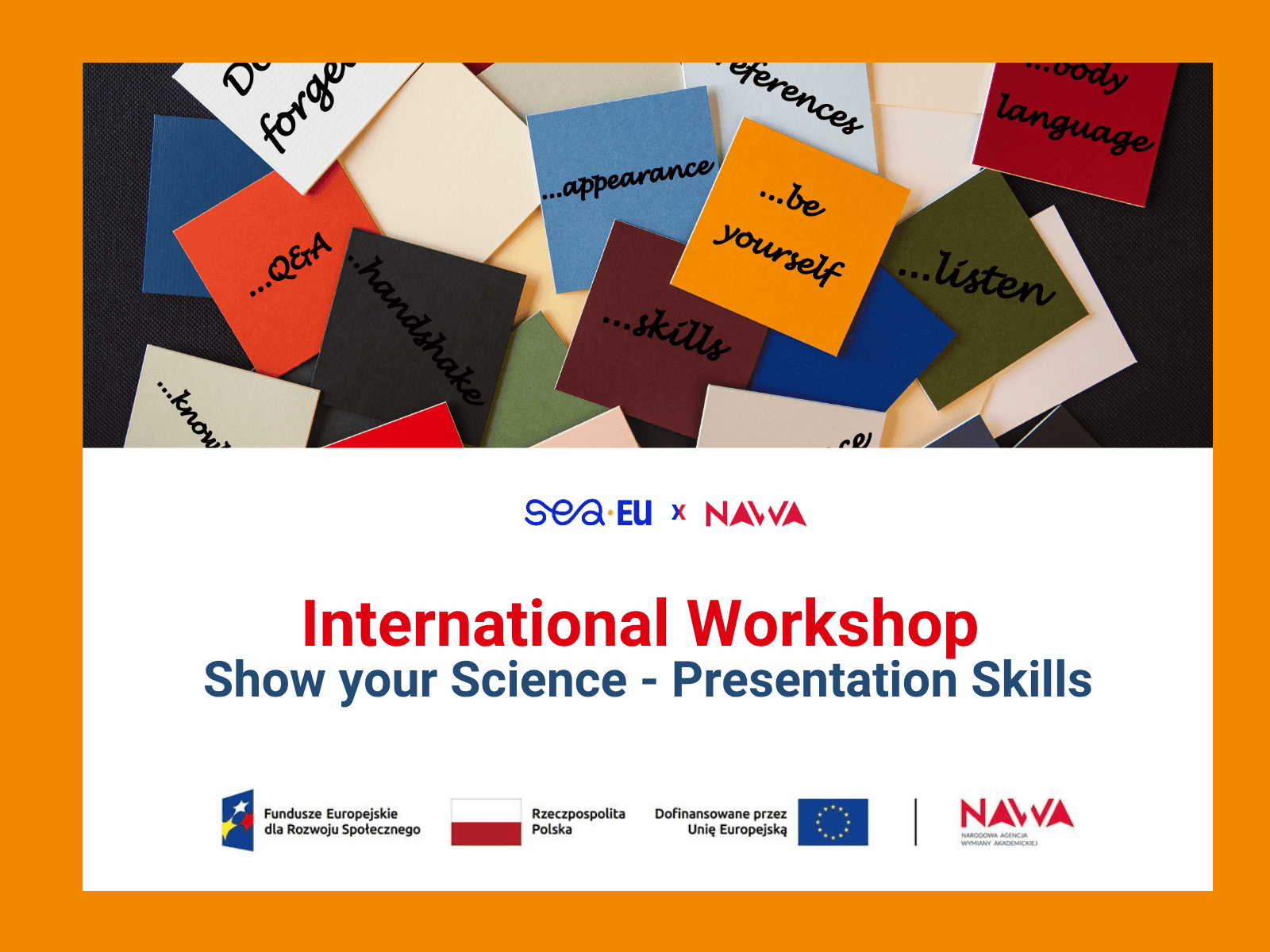
International Workshop “Show your Science – Presentation Skills”
Purpose
The aim of the „Show your Science – Presentation Skills” workshop is to develop participants’ competencies in the field of effective scientific communication by improving the skills of preparing and conducting engaging presentations and public speaking. Participants will learn methods of creating clear and convincing presentations, learn how to adapt the message to different groups of recipients and consciously use verbal and non-verbal communication. The workshops will also enable you to develop the skills to receive and give constructive feedback and build confidence when presenting research results.
Form and duration of the initiative
The initiative will be implemented in a stationary form at SEA-EU’s partner university, the University of Kiel, Germany, from 1 to 3 September 2026.
Program
REQUIREMENTS FOR THE INITIATIVE
Participants
Students and doctoral students of the University of Gdańsk can apply to participate in the initiative. Applicants must not apply for or participate in the program while on any leave.
Recruitment
Each person entering the recruitment process is required to fill out a special https://forms.cloud.microsoft/e/GKDQHrMhqB registration form. The form must be completed and sent by August 12, 2026. One of the elements of the form is the justification for choosing the workshop. The specificity, consistency and relevance of the answers to the individual situation of the candidate will be evaluated. The response should include:
- a description of the motivation to participate in the workshops and the need to develop presentation competences;
- a plan to use the acquired skills in the next 12 months (e.g. during scientific conferences, seminars, defence of a diploma or doctoral thesis, presentation of a research project, science popularization activities or other public appearances);
- a description of how participation in the workshop will affect the candidate’s scientific or professional development.
The order in which the grant is awarded depends on the total number of points obtained – applications with a higher sum of points have priority when awarding funding and will be implemented in accordance with the ranking list. Funds for this purpose are provided for 4 people.
Persons who have submitted a set of required documents and met the above requirements may be qualified for mobility.
Recruitment takes place taking into account the horizontal rules described in the Project Regulations § 2 point 8. If you need to provide support in the recruitment process for people with disabilities and special needs, please contact the coordinator of the seaenergy@ug.edu.pl task.
Admission criteria
| 1 | Formal criteria | Fulfilled |
| UG student/PhD student status | ||
| English language level minimum B2 | ||
| Complete application | ||
| Substantive criteria | Scoring | |
| 2 | Assessment of the justification for participation in the workshop and motivation to develop competences in the field of communication and scientific presentation. | 0-5 |
| 3 | Planned use of skills in the next 12 months (e.g. conference, thesis defense, speech, science popularization, project presentation). | 0-5 |
| 4 | The impact of participation in the workshop on the candidate’s scientific or professional development. | 0-5 |
Recruitment results
The committee verifying and evaluating the applications is obliged to prepare a ranking list divided into a list of qualified, reserve and non-meeting persons. All persons participating in the recruitment will be individually informed about its results by e-mail by August 13, 2026. The list of winners will also be available on the Offer – SEA-EU page.
RULES FOR PROVIDING SUPPORT
Participation in mobility for qualified students and doctoral students of the University of Gdańsk who meet the criteria is free of charge.
Co-financing
The grant can be awarded for mobility lasting from 1 to 3 September 2026 plus two days for travel. The subsidy must be used to pay for travel, accommodation and subsistence costs. A detailed list of co-financing rates can be found on the website.
The subsidy for the student is PLN 3875. The co-financing for a doctoral student is PLN 4125.
Pre-initiative documentation
Persons who will be qualified to take part in the initiative are obliged to:
- completing an electronic pre-test, in which the participant independently assesses the level of his/her skills before the course,
- registration on the NAWA platform confirming the eligibility of the project participant,
- signing a student mobility agreement/signing a doctoral mobility agreement,
- signing an application for a foreign mobility (doctoral students).
Documentation after the initiative
Persons who complete the initiative are obliged to:
- completing an electronic post-test, in which the participant independently assesses the level of his/her skills after completing the course
- present the original certificate of residence at the partner university,
- delivery of the event program with the Organizer’s seal and signature
Completing mobility
Those who complete the mobility will receive a certificate of completion of the workshops.
The verification of learning outcomes includes the completion of the posttest, in which the participant should obtain a higher number of points compared to the pretest to obtain the certificate of upskilling. Both tests are solved remotely via Microsoft Forms.
LEARNING OUTCOMES
A set of learning outcomes (competences):
- Knowledge of the principles of effective scientific communication, preparation of engaging presentations and techniques for presenting the results of scientific research, taking into account the needs of different groups of recipients.
- Ability to design and deliver short, persuasive scientific presentations using appropriate speech structure, elements of rhetoric, verbal and non-verbal communication, and visual materials to support the message.
- Social competences in the field of conscious and responsible communication of research results, building relationships with recipients, giving and receiving constructive feedback, and developing one’s own presentation competences through reflection and cooperation.
Learning outcomes:
- Knowledge:
1.1 Knows the principles of preparing effective scientific presentations tailored to diverse audiences.
1.2 Understands the basic models of communication and knows the techniques of building an engaging message, including the principles of storytelling, rhetoric and the conscious use of verbal and non-verbal communication. - Skills:
2.1 Can prepare a short, logically structured presentation or pitch on his/her own scientific research, tailored to recipients outside the narrow specialization.
2.2 Can consciously use elements of verbal and non-verbal communication (voice, posture, 2.3 contact with recipients, pace of speech) in order to increase the effectiveness of the speech.
Can prepare clear visual materials to support the presentation and effectively present them during the presentation. - Social competences:
3.1 Is ready to receive and provide constructive feedback to support his/her own and others’ development.
3.2. Understands the importance of conscious communication and responsible presentation of research results to various groups of recipients.
Learning outcomes criteria
| Learning Outcomes | Verification criteria | Form of verification |
| 1.1 Knows the principles of preparing effective scientific presentations. | 1.1 Explains the principles of the structure of the presentation, adapting the message to the audience and building an engaging speech. | Test |
| 1.2 Understands communication models and techniques of effective communication. | 1.2 Identifies elements of effective communication and indicates the role of verbal and non-verbal communication during speeches. | Test |
| 2.1 Prepares and presents a short scientific pitch. | 2.1 Develops a logical structure of the presentation, clearly presents the purpose and significance of the research and adapts the language to the audience. | Test |
| 2.2 It uses verbal and non-verbal communication techniques. | 2.2 Consciously uses eye contact, body language, voice modulation and pace of speech. | Test |
| 2.3 Prepares materials to support the presentation. | 2.3 Creates clear slides or other visual materials to support the message. | Test |
| 3.1 Gives and accepts constructive feedback. | 3.1 Formulates factual feedback and uses the received tips to improve his/her own speech. | Test |
| 3.2 Recognises the importance of effective scientific communication. | 3.2 Shows openness to the development of presentation competences and consciously adapts the method of communication to the needs of the recipients. | Test |
Contact to the coordinator: seaenergy@ug.edu.pl
The initiative is implemented as part of the project „Support for synergistic and complementary activities of the SEA-EU 2.0 – SEA-nergy project”, which is part of the NAWA program „Support for European Universities Alliances” from the European Funds for Social Development.
Graphic template: Izabela Ziomek, “SEA-nergy Project Information Graphics Template”, 2026. The original template design is licensed under Creative Commons Attribution 4.0 International (CC BY 4.0): https://creativecommons.org/licenses/by/4.0/. Logos, photographs and graphic elements from the Canva library are excluded from this licence.