BASIC INFORMATION
Name
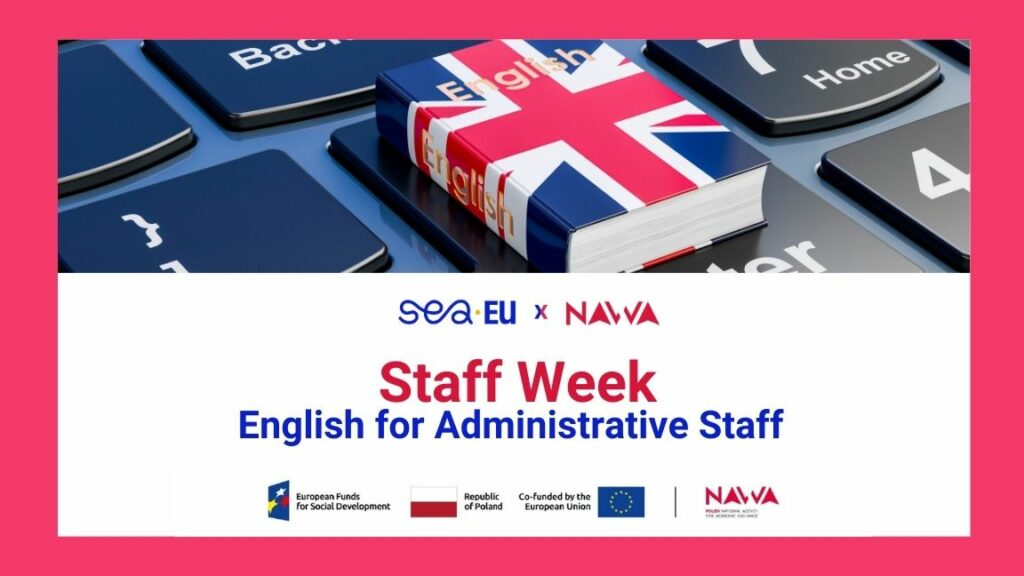
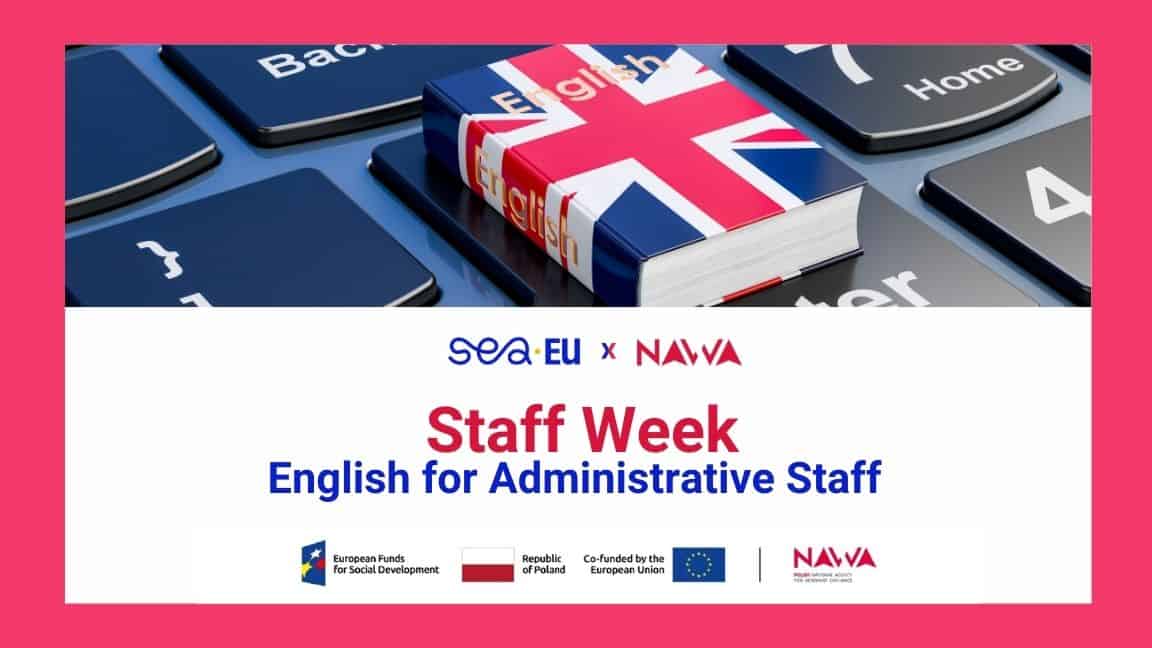
Staff Week – English for Administrative Staff
Purpose
The aim of the course is to develop communication and language skills in English, adapted to the specifics of administrative work at the university. The course program places particular emphasis on the practical application of the language in a professional context, including, among m.in, serving international students and staff, conducting correspondence, and attending meetings or conferences.
Form and duration of the initiative
The initiative will be implemented at the SEA-EU partner university at the University of Brest from 16 to 18 June 2026.
A set of learning outcomes (competences):
- Knowledge:
1.1 knows vocabulary and terminology related to the administration of a higher education institution,
1.2 understands the rules of writing formal and informal correspondence in English,
1.3 knows cultural differences and their impact on communication - Skills:
2.1 creates formal and informal correspondence with students and foreign employees,
2.2 conducts telephone calls and videoconferences,
2.3 provides information and explanations on administrative procedures - Social competences:
3.1 is ready to cooperate with people from different cultural backgrounds,
3.2 is aware of taking care of clear and precise communication,
3.3 is confident in conducting conversations and communication in English in professional situations
Criteria for assessing learning outcomes:
| Learning Outcomes | Verification criteria | Form of verification |
| 1.1 knows vocabulary and terminology related to higher education administration | 1.1.1 lists the names of office equipment 1.1.2 knows the types of names of university legal acts | Test |
| 1.2 understands the rules of writing formal and informal correspondence in English | 1.2.1 knows the rules of writing formal correspondence (official letters, email) 1.2.2 knows the rules of writing informal correspondence (e-mail to a student, a friend from a foreign university) | Test |
| 1.3 knows cultural differences and their impact on communication | 2.1.1 knows cultural differences and uses this knowledge in communication with foreign partners | Test |
| 2.1. creates formal and informal correspondence with students and foreign employees | 2.1.1 – can write a formal letter, e.g. an invitation to a conference 2.1.2. – knows how to write an e-mail message to a student, e.g. about the rules of applying for a scholarship | Test |
| 2.2. conducts telephone calls and videoconferences | 2.2.1 – can conduct telephone renewal 2.2.2 – can take an active part in videoconferencing | Test |
| 2.3. provides information and explanations on administrative procedures | 2.3.1 – can explain the rules of submitting applications for scholarships 2.3.2 – can indicate the place of submission of applications | Test |
| 3.1. is ready to cooperate with people from different cultural backgrounds | 3.1.1 – sends invitations to the conference to different cultural environments | Test |
| 3.2. is aware of taking care of clear and precise communication | 3.2.1 – verifies his/her written statements, also by asking for the support of other persons | Test |
| 3.3. is confident in conducting conversations and communication in English in professional situations | 3.3.1 – takes part in the discussion 3.3.2 – conducts telephone conversations | Test |
REQUIREMENTS FOR THE INITIATIVE
Participants
Persons with the current status of an administrative employee of the University of Gdańsk as of the date of joining the recruitment process and the planned initiative may apply for recruitment on the initiative. Persons taking part in the recruitment may not apply or implement the initiative while on any leave. The declared level of English of the participant is at least B1.
Recruitment
Each person entering the recruitment process is required to fill in a special registration form Registration form – mobility within the SEA-nergy project „English for …” – Fill in the form
One of the elements of the form is a cover letter justifying the choice of mobility, which should be used to improve competences. The letter should include information on how the topic of mobility is connected with professional/scientific work and how it will affect the development of the participant. The form must be completed and sent by March 11, 2026.
The order in which the grant is awarded depends on the total number of points obtained – applications with a higher sum of points have priority when awarding funding and will be implemented in accordance with the ranking list. Funds for this purpose are provided for 3 people.
Persons who have submitted a set of required documents and met the above requirements may be qualified for mobility.
Recruitment takes place taking into account the horizontal rules described in the Project Regulations § 2 point 8. If you need to provide support in the recruitment process for people with disabilities and special needs, please contact the coordinator of the seaenergy@ug.edu.pl task.
Admission criteria
| 1 | Formal criteria | Fulfilled |
| Status of an administrative employee | ||
| English language level minimum B1 | ||
| Complete application | ||
| Substantive criteria | Scoring | |
| 2 | Substantive evaluation of the motivation letter justifying the choice of mobility, which should be used to improve competences | 0-5 |
| 3 | Consistency of the thematic scope of training mobility with the professional work carried out | 0-5 |
| 4 | Previous participation in a language course within the SEA-nergy project | 0/5 |
Recruitment results
The committee verifying and evaluating the applications is obliged to prepare a ranking list divided into a list of qualified, reserve and non-meeting persons. All persons participating in the recruitment will be individually informed about its results by e-mail by March 13, 2026. The list of winners will also be available on the Offer – SEA-EU page.
RULES FOR PROVIDING SUPPORT
Participation in mobility for qualified employees of the University of Gdańsk who meet the criteria is free of charge.
Co-financing
The grant can be awarded for the implementation of mobility lasting from 16 to 18 June 2026 plus two days for travel. The subsidy is paid in the form of a lump sum of PLN 4625 (employee) or PLN 5250 (a person with at least a doctoral degree). The subsidy must be used to pay for travel, accommodation and subsistence costs. A detailed list of co-financing rates can be found on the website.
Pre-initiative documentation
Persons who will be qualified to take part in the initiative are obliged to:
- completing an electronic pre-test, in which the participant independently assesses the level of his/her skills before the course,
- registration on the NAWA platform confirming the eligibility of the project participant,
- request for a business trip on the employee’s portal,
- data to be transferred.
Documentation after the initiative
Persons who complete the initiative are obliged to:
- completing an electronic post-test, in which the participant independently assesses the level of his/her skills after completing the course
- present the original certificate of residence at the partner university,
- delivery of the event program with the Organizer’s seal and signature
Completing mobility
Those who complete the mobility will receive a certificate of completion of the course. The verification of learning outcomes includes the completion of the posttest, in which the participant should obtain a higher number of points compared to the pretest to obtain the certificate of upskilling. Both tests are solved remotely via Microsoft Forms.
Contact to the coordinator: seaenergy@ug.edu.pl
The initiative is implemented as part of the project „Support for synergistic and complementary activities of the SEA-EU 2.0 – SEA-nergy project”, which is part of the NAWA program „Support for European Universities Alliances” from the European Funds for Social Development.
Graphic template: Izabela Ziomek, “SEA-nergy Project Information Graphics Template”, 2026. The original template design is licensed under Creative Commons Attribution 4.0 International (CC BY 4.0): https://creativecommons.org/licenses/by/4.0/. Logos, photographs and graphic elements from the Canva library are excluded from this licence.